| |
Although represented in modern oceans by at least 15 genera and 89 species, this large family has few representatives in the waters of the Middle Atlantic States (1/Galeus, 1/Scyliorhinus and 1 or 2 Apristurus spp). Worldwide, the 13 species assigned to Scyliorhinus tend to regionally localized; Compagno (1984) notes none as being trans-hemispheric or trans-oceanic.
 In instances where multiple species share a range, their bottom structure and/or depth preferences tend to be different. For example, two species are broadly distributed through the Eastern North Atlantic and Mediterranean. Both are deemed common in inshore and offshore waters (1 - 125 m) and have somewhat similar diets (crustaceans, mollusks, worms, cephalopods and fish). The smaller (to 100 cm), S. canicula (LINNAEUS, 1758), prefers mud, sand or gravel while the larger species (to 160 cm), S. stellaris (LINNAEUS, 1758), prefers a rough bottom. Scyliorhinus retifer (GARMAN, 1881), the Chain catshark inhabits the outer continental shelf & upper slope (to 450m) of the Western North Atlantic from New England to Florida and the Gulf of Mexico to Nicaragua. In instances where multiple species share a range, their bottom structure and/or depth preferences tend to be different. For example, two species are broadly distributed through the Eastern North Atlantic and Mediterranean. Both are deemed common in inshore and offshore waters (1 - 125 m) and have somewhat similar diets (crustaceans, mollusks, worms, cephalopods and fish). The smaller (to 100 cm), S. canicula (LINNAEUS, 1758), prefers mud, sand or gravel while the larger species (to 160 cm), S. stellaris (LINNAEUS, 1758), prefers a rough bottom. Scyliorhinus retifer (GARMAN, 1881), the Chain catshark inhabits the outer continental shelf & upper slope (to 450m) of the Western North Atlantic from New England to Florida and the Gulf of Mexico to Nicaragua.
Fossil specimens attributed to this genus have been reported from Europe, Africa, Asia and North America.
Reports from the US Atlantic and Gulf coasts include:
Ward & Wiest (1990:84). In their checklist the authors included:
Scyliorhinus brivesi ARAMBOURG, 1952 - Piscataway & Paspotansa Mbrs (Late Palaeocene), Aquia Fm, MD
S. gilberti CASIER, 1946 - Brightseat (Early Palaeocene) thru Woodstock (Early Eocene) Formations of MD & VA
Welton & Farrish (1993:125) included an undetermined scyliorhinid from the Albian-Maastrichtian of Texas which would be later described by Cappetta & Case (1999).
Case (1994) included S. gilberti in the Early Eocene fauna of Mississippi.
This website originally reported S. "gilberti" as represented in the Eocene of Virginia, but these teeth were subsequently reassigned to Triakis.
Noubhani & Cappetta (1997:58-62) described three new species of catshark from the Paleogene of Morocco,
Scyliorhinus entomodon (Danian - Thanetian),
S. ptychtus (Thanetian - Ypresian) and
S. sulcidens (Thanetian).
Teeth comparing well to S. ptychtus have been found in the Selandian of Maryland and S. entomodon in the Selandian of Maryland and Ypresian of Virginia.
Case & Cappetta (1997:144-45) erected
Scyliorhinus ivagrantae for teeth from the Maastrichtian of Texas
Cappetta & Case (1999:30) described two new species from the Late Cretaceous of Texas:
Scyliorhinus. arlingtonensis Lower Cenomanian (=WF1993)
S. taylorensis Lower Campanian
Müller (1999:43-44) reported catsharks from the Aquia (Thanetian, VA), Piney Point (Ypresian, VA), Old Church (Oligocene, VA) and Belgrade (Oligocene, NC) Formations. All were included as Scyliorhinus sp except:
S. aff distans (PROBST, 1879) - Belgrade Fm., NC
Kent (1999:22-23) included S. gilberti from the Nanjemoy Fm (Ypresian) of Virginia.
Purdy et al (2001:139) included Scyliorhinus sp as a component of the Pungo River (units 1-5) and possibly Yorktown (Unit 1 ?redeposit) faunas.
Cappetta (1987:111) describes the catshark dentition as a clutching-type, but goes on to note that dentitions of the living species are poorly known and cautions against the assumption that the paleontological usage of the term "Scyliorhinus" equates with the definition of extant genus of that name.
In general, Scyliorhinus teeth are small with a narrow cusp, one or more lateral cusplets, basal wrinkles on the lingual face and an incomplete cutting edge. The basal face of the root is flat and the lingual protuberance quite strong. Kent (1994) notes that the root has one or more pairs of margino-lingual foramina, and that S. gilberti typically has two cusplets (primary cusplet larger) and S. brivesi two or three with the primary and secondary of similar size.
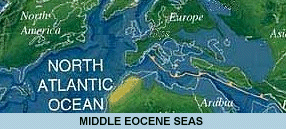 Not only should Cappetta's warning about the genus be considered, but also the propensity to equate the North American teeth with previously described European species. In recent seas, most species are localized and European species are not reported from North American waters. Not only should Cappetta's warning about the genus be considered, but also the propensity to equate the North American teeth with previously described European species. In recent seas, most species are localized and European species are not reported from North American waters.
Palaeocene
Although scarce, Scyliorhinus-like teeth are regularly found in Aquia sediments when screening is employed. They are usually recognized by their small size, labial ridges. lateral cusplet(s) and labially elongated lobes. The latter characteristic is useful in differentiating them from Triakis teeth. (Indiscernible in Figure , the labial face has relatively strong but short basal wrinkles which grow longer laterally reaching a mid-crown position. These folds can be seen on the lingual cusp-face as well, but they are much weaker; there is no discernable cutting edge.)
Eocene
The Nanjemoy Fm (Ypresian) yields catshark-like teeth, but most seem to better be referred to Triakis, Clearly scyliorhinid are those of Scyliorhinus cf entomotodon.
Miocene
Lee Creek reject material (mostly lower Pungo River Fm -- Lower Miocene) regularly yields small catshark-like teeth; many of these lack labial ridges and have not included. The included specimen (Fig. ) reflects characteristics associated with Scyliorhinus teeth.
Selected References
Cappetta, H., 1987. Chondrichthyes II: Mesozoic and Cenozoic Elasmobranchii. Handbook of Paleoichthyology, 3B. Gustav Fischer Verlag, Stuttgart and New York, 193 pp.
Cappetta, H. and Case, G., 1999. Additions aux faunes de sélaciens du Crétacé du Texas (Albien supérieur-Campanien). Palaeoichthyologica, 9, 5-111.
Case, G., 1994. Fossil Fish Remains fron the Late Paleocene Tuscahoma and Early Eocene Bashi Formations of Meridian, Lauderdale County, Mississippi. Palaeontographica Abt. A, 230, pp 97-138.
Case, G. and Cappetta, H. 1997. A new selachian fauna from the late Maastrichtian of Texas. Muünchener Geowissenschaften Abhandungen 34:131-189.
Compagno, L.J. 1984. FAO Species Catalogue, Vol 4, parts 1 & 2 Sharks of the World. United Nations Development Program.
Kent, B. 1994. Fossil Sharks of the Chesapeake Region. Egan Rees & Boyer, Maryland, 146 pp.
Kent, B. 1999. Sharks from the Fisher/Sullivan Site. In: Weems, R. & Grimsley, G., Early Eocene Vertebrates and Plants from the Fisher/Sullivan Site (Nanjemoy Formation) Stafford County, Virginia. Virginia Division of Mineral Resources, Pub 152: 11-37.
Müller, A. 1999. Ichthyofaunen aus dem atlantischen Tertiär der USA. Leipziger Geowissenschafteb, Leipzig, 9/10: 1-360.
Noubhani, A and Cappetta, H., 1997. Les Orectolobiformes, Carcharhiniformes et Myliobatiformes des Bassins à phosphate du Moroc (Maastrichtien-Lutétien basal)., PalaeoIchthyologica 8, München. 327 pp.
Purdy, R., Schneider, V., Appelgate, S., McLellan, J., Meyer, R. & Slaughter, R., 2001. The Neogene Sharks, Rays, and Bony Fishes from Lee Creek Mine, Aurora, North Carolina. In: Geology and Paleontology of the Lee Creek Mine, North Carolina, III. C. E. Ray & D. J. Bohaska eds. Smithsonian Contributions to Paleobiology, No 90. Smithsonian Institution Press, Washington D.C. pp. 71-202.
Ward, D. J. and Wiest, R.L., 1990. A checklist of Paleocene and Eocene sharks and rays (Chondrichthyes) from the Pamunkey Group, Maryland and Virginia, USA. Tertiary Res., 12(2) p 81-88.
Welton, B. and Farish, R., 1993. The Collector's Guide to Fossil Sharks and Rays from the Cretaceous of Texas. Before Time, Texas. 204 pp.
|