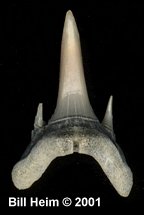
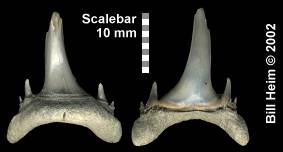
Odontaspis cf acutissima (AGASSIZ, 1844)
aka Carcharias reticulata (PROBST, 1879)
Odontaspis cf acutissima has been previously listed on this website and by many
authors as Carcharias reticulata. The teeth have long lateral and often doubled
cusplets and possess a delicate, slender main cusp. As had been pointed out, these
teeth are defined as being very similar to the Odontaspis-design except
possessing fine striations on the blade. Generally, Odontaspis teeth differ from
Carcharias by having the doubled cusplets more separated and often having a
third cusplet as well. What these teeth appear even more similar to are those of the
modern taxa, Odontaspis noronhai (MAUL, 1955) a
little known and rarely seen shark of the deep ocean.
Kent (1994) separated C. reticulata from Odontaspis "by the possession
of nearly complete cutting edges and very weak striations on the lingual face of the crown".
Purdy et al (2001) convincingly reassigned these teeth to Odontaspis.
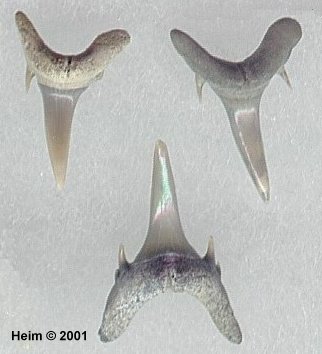 |
Fig. 1 - Odontaspis cf acutissima
lingual view of Pungo River specimens,
The largest tooth in this image is 21mm long. |