| |

 Like the larger C. leucus and C. obscurus, teeth of the Sandbar shark, Carcharhinus plumbeus comes in two varieties, a longer and more angular version (possibly male) and a more smoothly curved (possibly female) version. The most striking and identifiable feature of the teeth are the unusual thinness or flatness to the teeth. This combined with the fine and unusually even serrations give the teeth of this species a delicate look and feel compared with those of other Carcharhinus species.
Lower teeth are extremely finely serrated and vertically erect all along the jaw. They have prominent enamel shoulders. Anterior lower teeth are long for this genus. As one progresses laterally, the lower teeth become shorter with the root remaining wide. Another unusual aspect is that the root lobes begin vanishing until the bottom of the roots are rounded off and lacking the distinct root lobes prevalent in most shark teeth.
This species is uncommonly found in both the Yorktown and Pungo River formations.
 |
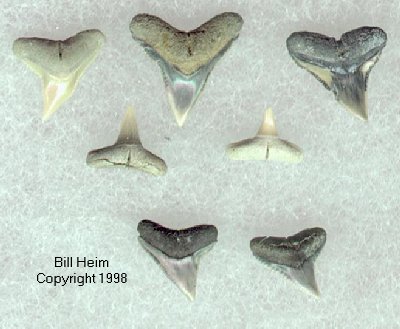 |
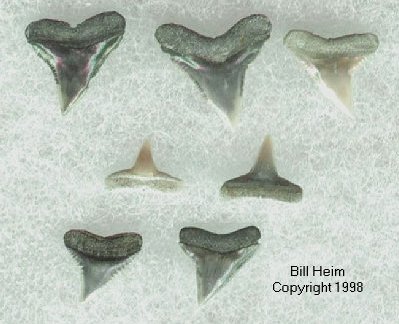
Carcharhinus plumbeus
Fig. 1 - labial and Fig. 2 - lingual views
Illustrated are:
Male? upper lateral, upper anterior, upper lateral, lower lateral, lower anterior;
Female? upper lateral, upper anterior.
The largest tooth measures 17mm slant by 15mm wide. |
|